Will AI Replace DevOps and AWS Engineers? What You Should Actually Focus On
Summary
AI is not replacing DevOps and AWS engineers. But it is changing what the work looks like. Here's the realistic answer about AI's impact and exactly what you should focus on to remain valuable in 2026 and beyond.
The Question Everyone Keeps Asking
Will AI replace me? If I learn DevOps and AWS now, will my skills be obsolete in two years when AI is smarter?
It is a fair question. AI is getting better at generating code, understanding errors, and suggesting solutions. So the fear is understandable.
But the answer is more nuanced than "yes" or "no."
Here is what is actually happening:
AI will not replace DevOps and AWS engineers.
But AI is changing what engineers are expected to do, and the bar is moving higher.
Let me explain.
What AI Can Actually Do Right Now
Let's be honest about AI's current capabilities:
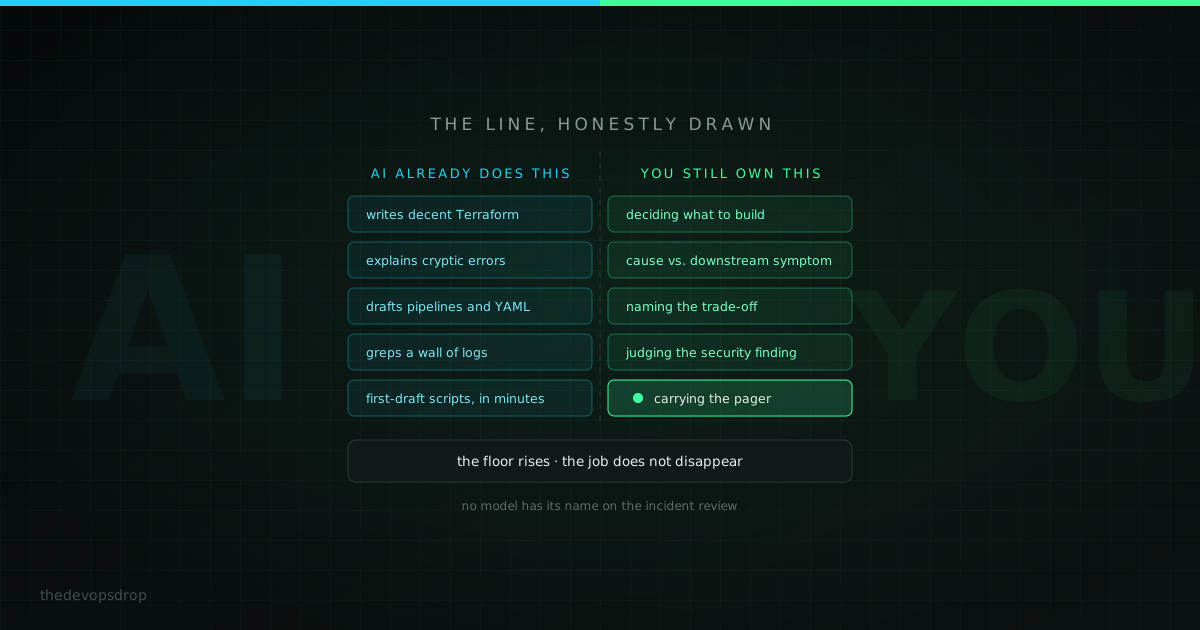
AI can generate Terraform code for common infrastructure patterns.
AI can explain AWS errors and suggest fixes.
AI can write shell scripts and Python automation.
AI can generate CI/CD pipeline configurations.
AI can analyze logs and identify patterns.
AI can create Kubernetes manifests and Helm charts.
AI can write documentation.
AI can suggest architecture improvements based on requirements.
These capabilities are real and useful. They speed up work that used to take hours.
But notice what is missing: AI does not own systems. AI does not make decisions. AI does not carry pagers. AI does not get called at 3 AM when production is down.
What AI Cannot Do
AI cannot decide what should be built.
If you ask AI to create an infrastructure design for a new application, AI can generate options. But AI does not know your company's budget, regulatory requirements, risk tolerance, existing systems, team expertise, or business constraints.
The AI generated design might be technically sound but completely impractical for your situation.
AI cannot troubleshoot complex production problems.
AI might identify a symptom: "High database latency." But is that the root cause or a symptom of something else? Should you scale the database, query better, or investigate the application code? AI cannot know.
AI cannot make trade-offs.
The cheapest architecture is not always the best. The most reliable option might be overkill. The fastest solution might create security risks. Making these trade-offs requires human judgment about what actually matters for your business.
AI cannot take responsibility.
When something goes wrong in production, someone needs to own it, investigate it, and fix it. That someone is a human engineer with their name attached to the decision.
AI cannot secure systems properly.
AI can identify obvious misconfigurations. But it can miss subtle security issues. It can also generate false positives that waste engineering time. Ultimately, a human needs to validate that security decisions are correct.
AI cannot operate complex systems reliably.
There is a difference between generating code and maintaining a system that runs 24/7, handles millions of requests, needs to scale, needs to be monitored, needs to be updated, needs to be secured, and needs to recover from failures.
That takes human expertise and judgment.
The Real Way AI Is Changing The Work
Here is what is actually happening:
Basic, repetitive, straightforward tasks are becoming less valuable because AI can do them quickly.
That does not make those tasks disappear. It means the bar for doing them shifts.
An engineer who can only write basic Terraform or follow deployment checklists is becoming less valuable.
An engineer who can understand the system, make architectural decisions, troubleshoot complex issues, improve reliability, secure the infrastructure, and use AI to work faster is becoming more valuable.
The expectation is rising.
Companies used to accept: "Our DevOps engineer creates VMs, writes basic scripts, and follows runbooks."
Now companies expect: "Our DevOps engineer designs systems, automates processes, troubleshoots production issues, improves reliability, controls costs, and uses AI to work faster."
That is the shift.
For Beginners - What Should You Actually Focus On
If you are starting from zero, do not panic about AI. Instead, build a strong foundation.
The mistake beginners make is trying to compete with AI at writing code. Do not do that.
Instead, focus on understanding systems.
Learn the fundamentals:
- Linux: How operating systems work, file systems, permissions, processes, networking
- Networking: IP addresses, DNS, load balancing, routing, protocols
- Databases: How relational and NoSQL databases work, indexing, replication
- Git: How version control works, branching, merging, collaboration
- HTTP and APIs: How web applications communicate
- Security basics: Encryption, authentication, authorization, secrets management
These skills matter more than memorizing AWS services or learning 20 DevOps tools.
Then learn the tools:
- AWS: Start with EC2, VPC, S3, RDS, Load Balancers
- Infrastructure as code: Learn Terraform properly
- Docker: Build and run containers
- CI/CD: Learn one platform well like GitHub Actions
- Monitoring: Understand logs, metrics, and alerting
But do not just memorize tools. Build projects.
Create a real application. Deploy it on AWS using Terraform. Put it in Docker. Create a CI/CD pipeline. Add monitoring. Secure it. Document it.
That one project teaches more than 50 separate tutorials.
Then use AI.
When you get stuck, ask AI for help. When you do not understand an error, ask AI to explain it. When you need to write a script, ask AI to help you create a first version.
But always review what AI generates. Understand it. Validate it. Learn from it.
This is how you stay ahead of AI: by understanding systems deeply enough that you can evaluate AI-generated solutions.
Beginners who focus on understanding systems will be far more valuable than beginners who focus on competing with AI at writing code.
For Experienced Engineers - How To Stay Valuable
If you already work in DevOps or AWS, you have two choices:
Choice 1: Keep doing what you are doing, the same way you are doing it.
Result: AI-assisted engineers will replace you because they can do your work faster.
Choice 2: Use AI to eliminate basic repetitive work and spend your time on harder problems.
Result: You become more valuable.
Here is what that looks like in practice:
You used to spend 2 days writing a deployment automation script.
With AI, you can create a first version in 2 hours.
Now you have 1.5 days left. Do not just call it done.
Spend that time improving the automation. Handle edge cases. Test failure scenarios. Add monitoring and alerting. Write documentation. Make it maintainable. Integrate it with other systems. Train others to use it.
You moved from "writing scripts" to "engineering systems."
Similarly:
You used to spend a day troubleshooting a production issue.
With AI-assisted log analysis, you find the root cause much faster.
Do not stop there.
Spend the extra time on fixing the underlying problem so it does not happen again. Improve monitoring to catch it earlier next time. Write a runbook. Automate the recovery. Update documentation.
You moved from "fixing problems" to "engineering reliability."
Or:
You used to spend hours creating an AWS infrastructure design.
With AI, you can generate architecture options much faster.
Do not stop there.
Evaluate each option against your requirements. Consider security, cost, scalability, operational complexity, and risk. Make a decision with full understanding. Validate it with the team. Document the trade-offs.
You moved from "creating designs" to "making engineering decisions."
This is how experienced engineers stay valuable: by using AI to eliminate the busywork and spending time on what actually requires human judgment.
The Skills That Matter More Than Ever
As AI gets better at generating code and configurations, certain skills become even more important:
System thinking: Understanding how all the pieces fit together.
Problem solving: Breaking down complex situations and finding root causes.
Decision making: Weighing trade-offs and making choices with incomplete information.
Communication: Explaining technical decisions to non-technical people.
Security thinking: Understanding how systems can be attacked and how to defend them.
Business thinking: Understanding how technical decisions affect the business.
Troubleshooting: Finding and fixing problems that AI cannot diagnose.
Design: Creating systems that are reliable, secure, scalable, and maintainable.
Automation: Building systems that require less human intervention.
Learning: Continuously learning new technologies and approaches.
These skills cannot be easily automated. They require experience, judgment, and understanding.
The engineers who develop deep expertise in these areas will be valuable regardless of AI.
What Hiring Managers Should Actually Look For
If you are hiring DevOps or AWS engineers, stop focusing on tool lists.
A resume that says "AWS, Kubernetes, Terraform, Jenkins, Docker, Python" does not tell you whether someone can actually design and operate production systems.
Instead, look for:
Problem solving: Ask candidates how they would troubleshoot real scenarios.
"Our deployment worked in staging but failed in production. Walk me through how you would investigate."
"AWS costs suddenly spiked by 40%. What would you check?"
"The application is returning intermittent 500 errors. Where would you start?"
These questions reveal far more than asking candidates to define IAM or Kubernetes concepts.
System understanding: Ask candidates to design something.
"Design a highly available web application on AWS that serves millions of users globally."
"Design a CI/CD pipeline for a team of 50 developers pushing code 100 times per day."
"Design a disaster recovery strategy for our production database."
Real engineering thinking shows in these answers, not in someone's ability to memorize AWS documentation.
Troubleshooting: Present a broken system and see how they approach it.
"This Kubernetes cluster keeps evicting pods randomly. What could cause this and how would you debug it?"
"Our Terraform apply is randomly failing with authorization errors. How would you investigate?"
Judgment: Ask about trade-offs.
"We could use Kubernetes or just use ECS. What is the trade-off and which would you recommend?"
"We could make this infrastructure more secure but it would be slower. How would you think about this trade-off?"
Candidates who think through implications are stronger than candidates who give you the "textbook" answer.
Hire people who can think, not people who have memorized the most tools.
The Real Future of DevOps and AWS Engineering
DevOps and AWS roles are not disappearing. In fact, they are becoming more important as more companies move to cloud infrastructure.
But the nature of the work is changing:
Basic tasks are increasingly automated or AI-assisted.
That means the human work is shifting to harder problems: design, troubleshooting, decision making, security, reliability, cost optimization.
These are not easier problems. They require more judgment, more experience, and more thinking.
So in a way, AI is making DevOps and AWS engineering more challenging and more valuable, not less.
The weakest engineers are those who only do basic tasks. AI replaces them.
The strong engineers are those who solve complex problems. AI helps them do those better.
Practical Steps for Right Now
If you are worried about staying relevant in an AI world, here is what to actually do:
Step 1: Build your foundation
Make sure you understand systems, networking, databases, security, and how applications work. These skills do not become obsolete.
Step 2: Learn by building
Do not learn tools in isolation. Build complete projects that exercise your understanding.
Step 3: Use AI as a tool
Stop seeing AI as competition and start seeing it as an assistant. Use it to work faster on routine tasks.
Step 4: Develop deep expertise
Pick an area and get very good at it: reliability, security, cost optimization, architecture design, or automation. Deep expertise is harder to replace than broad surface knowledge.
Step 5: Focus on judgment
Spend time on decisions that require human judgment: architecture trade-offs, security validation, cost optimization, incident response. These are where you stay valuable.
Step 6: Stay curious
The cloud industry changes constantly. New services launch. AI gets better. Technologies evolve. Staying valuable requires continuous learning.
Step 7: Communicate well
The ability to explain technical decisions to non-technical people is increasingly rare and increasingly valuable. Develop this skill.
Final Answer to The Original Question
Will AI replace DevOps and AWS engineers?
No.
But AI will make basic work less valuable and harder work more important.
The engineer of 2026 will be someone who:
- Understands cloud systems deeply
- Can troubleshoot complex production issues
- Can design reliable, secure, scalable systems
- Can use AI to eliminate repetitive work
- Can validate AI-generated solutions critically
- Can make architectural decisions
- Can communicate technical concepts clearly
- Can balance cost, reliability, security, and business needs
That engineer will be far more valuable than today's engineer, and AI will have made the work more interesting, not less.
If you focus on building deep understanding, developing judgment, and learning to work effectively with AI, you will be secure.
If you only memorize tools and follow checklists, AI will eventually replace you.
The choice is yours.
One More Thing
The scariest phrase for a DevOps engineer in 2026 is not "AI will replace you."
It is "AI can do that task faster."
Because if that is all you do, you are in trouble.
The safest phrase is: "I can understand systems deeply, troubleshoot complex problems, make sound decisions, and use AI to work faster."
That is the engineer AI cannot replace. That is the engineer companies will fight over.
Build toward that.