AWS Well-Architected Framework: What You Actually Need to Understand
Summary
The AWS Well-Architected Framework is a proven approach to evaluating and improving cloud architectures. Learn the six pillars and how to apply them to build systems that are secure, reliable, efficient, and cost-effective.
Most people treat the Well-Architected Framework as another AWS thing to memorise for a certification. It isn't really that.
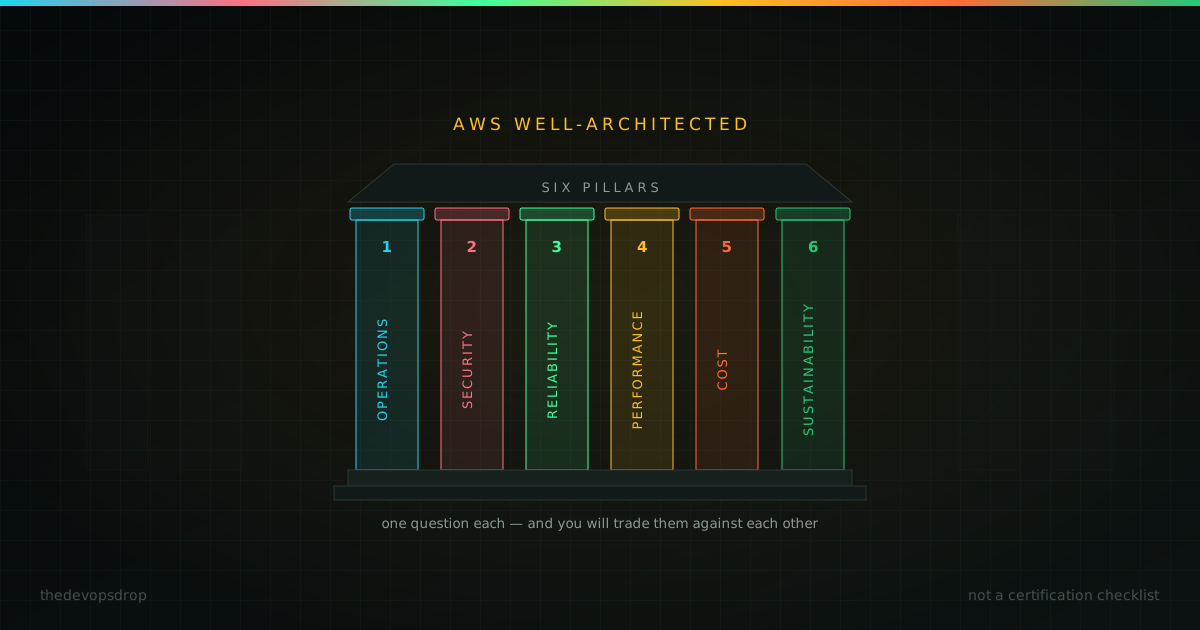
It's a checklist for one question: are we building and running this the right way? AWS splits that into six pillars, and each pillar is basically one question you should be asking anyway.
1. Operational Excellence
Can we actually run, monitor, and improve this?
This is about operations, not architecture: deployments, monitoring, automation, incident response, and whether the team gets better at running the thing over time.
Build it properly, run it properly, keep improving it.
2. Security
Is the application and its data protected?
Identity, permissions, data protection, network security, and detecting and responding to incidents. In practice: who can reach the application, who can reach the database, where are the credentials, is the data encrypted, and what happens when something looks wrong.
Make sure the wrong person can't get to the wrong thing.
3. Reliability
What happens when something fails?
Because it will. Instances die, networks partition, dependencies degrade, AWS services have bad days. A reliable architecture keeps working through that or recovers quickly, which means backups you've actually restored from, no single points of failure, high availability where it matters, and a DR plan someone has tested.
Don't just ask "does it work?" Ask "what happens when it stops?"
4. Performance Efficiency
Are we using the right resources for the job?
The right compute option for the workload, a database that can handle the load, no resources sitting idle, and headroom for traffic to grow. And because both your workload and AWS's service catalogue change, this needs revisiting rather than deciding once.
Get the performance you need without overbuilding.
5. Cost Optimization
Are we getting value for what we spend?
Are we running things nobody uses? Are the instances oversized? Would a managed service be cheaper once you count the operational time? Does this really need to run 24/7?
Don't spend money on infrastructure that isn't doing anything for you.
6. Sustainability
Are we using resources efficiently?
Maximise utilisation, cut waste, prefer more efficient hardware and software options where you have the choice. This overlaps heavily with cost optimisation: idle compute is wasteful in both senses.
Use what you need, and not more.
The six in one table
| Pillar | The question |
|---|---|
| Operational Excellence | Can we run and improve it? |
| Security | Is it protected? |
| Reliability | What happens when it fails? |
| Performance Efficiency | Is it performing efficiently? |
| Cost Optimization | Are we spending wisely? |
| Sustainability | Are we wasting resources? |
What it looks like on a real project
Say your team is building an online store. The obvious question is "can we build it?" The framework adds five more:
How will we deploy, monitor, and operate it? Who can reach customer and payment data? What happens when a component fails? Can it absorb a sudden surge of customers? Are we paying for anything we don't need?
None of these are exotic. They're just easy to skip when you're focused on shipping.
The part people miss: trade-offs
Well-architected doesn't mean maximising all six pillars simultaneously. That's not possible and it isn't the goal.
A dev environment should probably optimise for cost and accept that it goes down sometimes. A payments system should optimise for reliability and eat the infrastructure bill. AWS says this explicitly: trade-offs are part of the design, not a failure of it.
The question isn't "how do we make this maximally available, secure, and fast?" It's "what does this workload actually need, and what are we willing to give up for it?"
What's worth knowing
You don't need the question list memorised. You need the habit of looking at an architecture and asking: is it secure, is it reliable, can we operate it, will it perform, are we overspending, are we wasting capacity.
If that's how you already think when reviewing a design, you've got the framework. AWS also ships the Well-Architected Tool, which walks a workload through the questions formally and produces recommendations, useful for a structured review but unnecessary for day-to-day thinking.
The one thing to hold onto: this isn't a one-time exercise. Traffic changes, requirements change, AWS launches things that make your old decision wrong. Re-run the questions as the workload evolves.