10 AWS and DevOps Roles That Matter in 2026 - What Each One Actually Does
Summary
Not all AWS and DevOps roles are the same. From Cloud Engineers to Platform Engineers to SREs, each role has different responsibilities. Here's what companies actually expect from each one and where they fit in modern organizations.
"DevOps engineer" has become a catch-all title that covers about six different jobs. That's fine until you're job hunting, negotiating scope, or hiring: then the differences matter a lot.
Here's what each of the common roles actually does day to day, and what AI is changing about them.
1. Cloud Engineer
The usual entry point. You build and run infrastructure on AWS: EC2, VPC, S3, RDS, Lambda, load balancers, auto scaling, CloudWatch, Route 53, IAM.
But nobody hires you to know those services in isolation. They hire you to answer questions like: how should this app be deployed? How should the network be laid out so it's both secure and fast? How does access control work across a dozen accounts? What happens when traffic triples? What's our recovery story? And increasingly, why is the bill so high?
That last one has gone from an afterthought to a standing agenda item.
What AI changes: you can get a working Terraform template for a standard architecture in seconds. You still have to review it. If it quietly makes a bucket public or writes an IAM policy with a wildcard in it, that's on you. The question shifted from "can you build infrastructure?" to "can you design it, secure it, and operate it?"
2. DevOps Engineer
You sit between developers and infrastructure, and the mission is simple: help people ship faster without breaking things.
In practice that's pipelines, container registries, deployment failures at 5pm on a Friday, automation scripts, infrastructure as code, and a steady stream of "it works on my machine" debugging. Tools vary (Git, GitHub Actions, GitLab CI, Jenkins, Docker, Kubernetes, Terraform, Ansible, CodePipeline), but the job is always automating the path from commit to production.
You don't need to be a software developer, but you do need to understand how applications actually work. The good ones can look at a failed deploy and tell you whether the problem is the code, the infra, the config, the secrets, or the pipeline itself. That instinct is most of the value.
What AI changes: it writes decent pipeline boilerplate, Dockerfiles, and Terraform. The gap is between "AI generated my pipeline" and "I understand my pipeline and used AI to fix it faster." Only one of those people can debug it at 2am.
3. Site Reliability Engineer
People conflate SRE with DevOps, but the focus is different. DevOps is mostly about delivery. SRE is mostly about what happens after the deploy.
An SRE cares whether the service is up right now, whether it's fast enough, how often it breaks, how fast it recovers, and whether any of that is inside the error budget. The vocabulary (SLIs, SLOs, error budgets, incident command) comes from Google's SRE practice and has been adopted fairly broadly.
When production breaks, the SRE usually leads the investigation. That means reading logs, metrics, traces, database behaviour, and infrastructure state at the same time and forming a theory quickly. It's a broad job: you might need to understand application code, Postgres query plans, Kubernetes scheduling, and VPC routing in the same hour.
The other half is prevention: designing monitoring that catches things earlier, writing runbooks, making deploys safer, planning capacity before it becomes an incident.
What AI changes: log search and anomaly correlation get genuinely faster. But incidents carry risk. Knowing that AI suggested a cause is different from knowing it's right, and different again from knowing the proposed fix is safe to apply to a live system right now.
4. Platform Engineer
Newer, and growing fast. Instead of every team building their own infrastructure, pipelines, and monitoring, one team builds an internal platform the rest self-serve from.
It's infrastructure as a product. A developer picks "new production service" and the platform provisions the AWS resources, wires up a pipeline, configures monitoring and security policy, handles DNS and secrets, and hands back a deploy target.
That's a wider skill set than traditional infra work: AWS, Kubernetes, IaC, CI/CD, APIs, security, observability, plus actual software engineering. And because your users are developers, you have to care about their experience: docs, error messages, support. Platform engineering is much closer to product work than to sysadmin work.
What AI changes: it speeds up building the platform, and it may end up inside the platform. "Deploy this with two replicas, HTTPS, monitoring, and a staging environment" translated straight into infrastructure actions is a plausible near-term product. This is probably where AI lands hardest in infrastructure.
5. DevSecOps Engineer
Security folded into the delivery process, on the theory that finding problems the week before launch is too late.
You're integrating security tooling into pipelines and infrastructure code: vulnerability scanning, container image scanning, secrets management, policy-as-code, compliance evidence. The questions are concrete: is that bucket readable by the world, is that IAM role scoped too broadly, is there a key in Git history, does this base image have known CVEs, is that endpoint actually authenticated?
You need to understand both how systems get deployed and how they get broken into. Reviewing a pipeline and spotting the risk before it ships is the whole skill.
What AI changes: good at surfacing misconfigurations and suspicious patterns, but this is a domain where blind trust is expensive both ways. False positives burn engineering time; false negatives turn into breaches. You need the fundamentals to judge the output.
6. Cloud Security Engineer
Narrower and deeper than DevSecOps: securing the cloud environment itself. IAM, Organizations, Control Tower, Security Hub, GuardDuty, CloudTrail, KMS, network security.
You design policies, monitor for threats, respond to events, manage encryption and key rotation, and produce compliance evidence. To do any of it you first have to understand how the infrastructure works: you can't secure a VPC you can't draw.
There's also a diplomacy element. Controls that are too tight slow everyone down and get routed around. Controls that are too loose don't do anything. Finding the line is the job.
What AI changes: helpful for triaging alerts, searching logs, and drafting policy reviews. The recommendations still need validating against your environment and your actual risk tolerance.
7. Kubernetes / Cloud-Native Engineer
For organisations running containers at scale, this becomes its own specialism: deployments, networking, storage, resource limits, autoscaling, security policy, and cluster-level monitoring. Kubernetes, Docker, Helm, registries, EKS or equivalent.
What companies want is rarely someone who knows the commands. They want someone who can say why Kubernetes is the right choice for this workload (and when it isn't), how service discovery works, how workloads scale, why a pod is stuck, and how to keep the cluster from quietly costing a fortune.
What AI changes: troubleshooting help is genuinely good: paste a CrashLoopBackOff and get a sensible list of causes. Generating manifests is fine too. Applying generated YAML without reading it is how you end up with a privileged container you didn't ask for.
8. Solutions Architect
You design the system rather than build every piece of it.
The input is a business problem: ten million users worldwide, needs high availability, disaster recovery, a specific compliance posture, and predictable costs. The output is a set of decisions about compute, data stores, networking, messaging, security architecture, and recovery.
It needs breadth rather than depth, plus communication skills. A good architect can explain to a non-technical stakeholder why the more expensive option is the right one, or why it isn't.
The main thing to internalise: cheapest isn't best, most scalable is often unnecessary, and the most secure design may be too rigid to work with. The job is balancing those, and that requires business context AI doesn't have.
9. Cloud Automation Engineer
Some organisations carve out a role purely for this. The premise: if someone does it by hand more than twice, it should be scripted. Python, Bash, Terraform, Ansible, the AWS CLI, APIs, CI/CD.
What AI changes: more here than anywhere else in the short term. Script generation is fast now. That doesn't remove the role, it moves it. Instead of two days writing a basic script, you spend twenty minutes on the first draft and the rest of the time on the parts that matter: edge cases, failure modes, integration, permissions, and making it something the next person can maintain. From writing code to engineering systems.
10. FinOps / Cloud Cost Engineer
You can have a technically excellent architecture and a terrible bill. FinOps is the discipline of making sure spend maps to value.
Cost Explorer, finding idle and oversized resources, Reserved Instances and Savings Plans, storage lifecycle policies, and, often the biggest win, helping teams make cost-aware design decisions before they build.
The classic example: a dev environment running production-sized infrastructure 24/7 for a team that works 9 to 6. Nobody did anything wrong; nobody was looking either.
It needs both sides: knowing which services are expensive and how their pricing actually works, and being able to explain a trade-off to finance and engineering in the same meeting.
What AI changes: usage analysis and anomaly detection get easier, which means less time in spreadsheets and more time on the structural fixes.
Where the roles differ
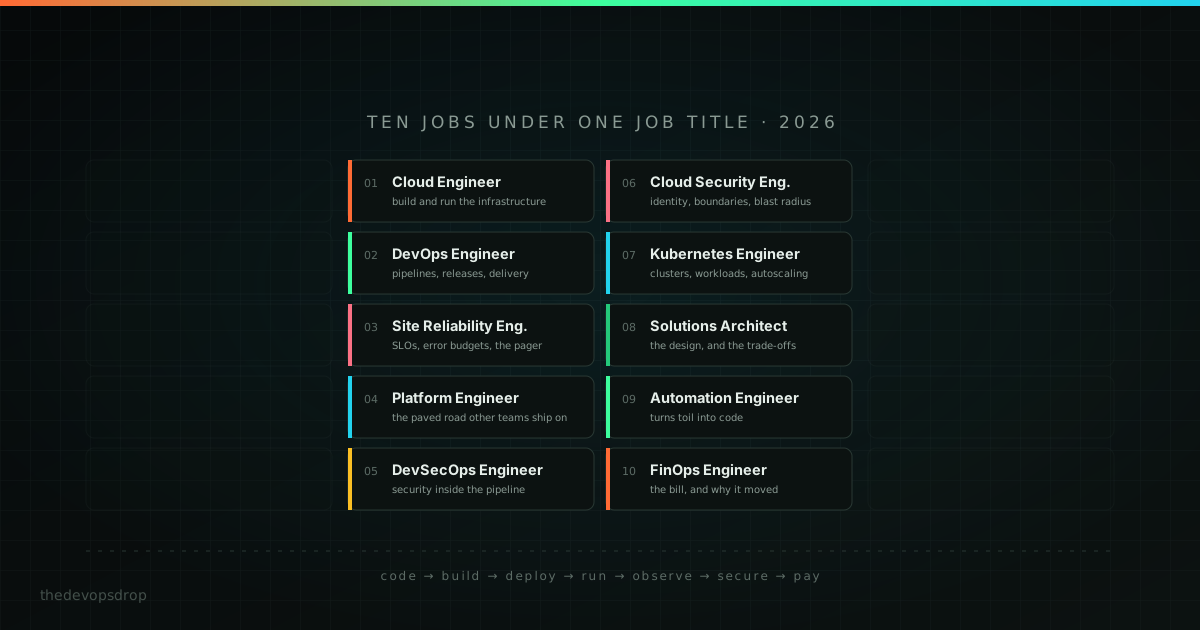
| Role | Main responsibility |
|---|---|
| Cloud Engineer | Build and operate cloud infrastructure |
| DevOps Engineer | Automate software delivery |
| SRE | Keep production reliable |
| Platform Engineer | Build platforms for developers |
| DevSecOps Engineer | Integrate security into delivery |
| Cloud Security Engineer | Secure cloud environments |
| Kubernetes Engineer | Operate container platforms |
| Solutions Architect | Design cloud solutions |
| Automation Engineer | Remove repetitive manual work |
| FinOps Engineer | Control and optimise cloud costs |
In practice these overlap heavily. One company calls the job "DevOps Engineer" and expects platform work, SRE duties, AWS infrastructure, and Kubernetes operations from one person. Another has separate teams for each. Read the job description, not the title.
They're all the same pipeline
Code gets committed. Tests run. It gets built and packaged. Security checks run. It deploys to cloud infrastructure. It runs in containers or on instances. It's monitored. Alerts fire. Someone investigates.
Every role above owns one or two stages of that. The Cloud Engineer builds what it runs on, the DevOps Engineer automates the path, the SRE keeps it up, the Platform Engineer makes it self-service, the security roles make sure it doesn't leak. The people who are good at any of these understand how their stage connects to the rest.
Which one should you aim for?
Foundation first: Linux, networking, Git, scripting, databases, how applications actually work. Everything above sits on that.
Then pick based on what you enjoy. Building infrastructure points to Cloud Engineer. Automating delivery points to DevOps. Liking the adrenaline of production debugging points to SRE. Security interest points to DevSecOps or Cloud Security. Liking code and abstractions points to Platform Engineering.
Pick one, get properly good, then widen. Trying to learn all ten at once gets you a resume full of tools and no depth in any of them, which is exactly what the market has stopped paying for.